

Application form
Thank you! Your submission has been received!
Oops! Something went wrong while submitting the form.
Blog
Украинская логистика сегодня
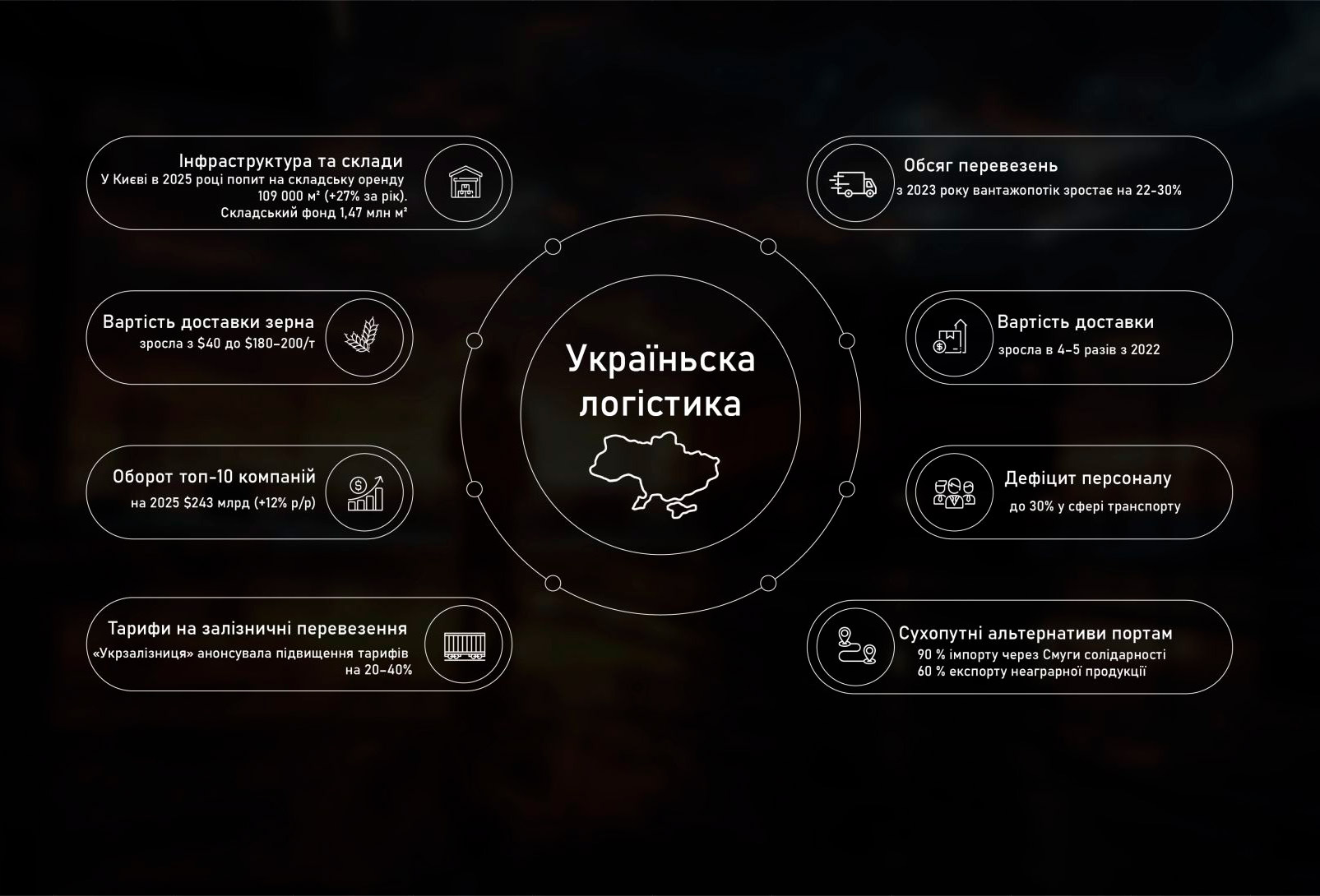
Logistics today is not just the transport of goods from point A to point B. It is a complex ecosystem where thousands of routes, hundreds of warehouses and tens of thousands of orders are intertwined every day. In Europe, this market is growing fast thanks to the boom of e-commerce, new transparency requirements and strict regulatory standards. In Ukraine, logistics is facing unprecedented challenges: destroyed infrastructure, rising delivery costs, staff shortages and the realignment of routes towards the EU.
In such conditions, TMS (Transportation Management System) ceases to be an «option» for companies. It becomes the central tool of business survival, efficiency and competitiveness. European market TMS 2024 - 20292024: €1.4 billion, forecast for 2029: €2.5 billion, CAGR 12.2%Alternative valuation (USD): 2023: $3.45 billion to 2030: $8.93 billion, CAGR 14.6% European market is growing due to: explosive growth in e-commerce (more than €950 billion in 2024) development of multi-channel delivery Shortage of personnel in logistics and drivers requirements for environmental sustainability (Green Deal reduction of mileage and emissions)
Logistics in Ukraine: challenges and opportunities Why Ukraine needs TMS now. Adapting to new routes When traditional seaports are unavailable, and transit is redirected to Poland, Romania, and the Danube, only automation allows for fast routing with hundreds of restrictions. Cost control in crisis conditions and rising fuel prices and tariffs make logistics a costly element of business. TMS reduces mileage, removes «empty kilometres» and optimizes costs by 8-12%. Efficiency in a shortage of images Fewer drivers and dispatchers is a challenge. But the TMS takes over some of the functions: automatically balances the load, reduces manual work. Integration with the EU The Ukrainian logistics market is increasingly integrated into European chains. TMS allows you to work on the same standards: transparency, SLA, analytics.
Conclusions
The European TMS is already a standard without which logistics cannot be competitive. Companies that invest in automation reduce costs, increase transparency and scale more easily into new markets. For Ukraine, TMS is more than technology. It’s a bridge to the future. In war and infrastructure reconstruction, TMS helps businesses adapt to constant change, plan complex routes through different countries and corridors, avoid overloading warehouses and provide service to customers even in crisis conditions. Strategic outlook: Ukrainian companies that implement TMS today will have two advantages: Operational - cost control, speed and accuracy of delivery Long-term - readiness to integrate into European logistics after post-war reconstruction. In 2025, TMS for Ukrainian logistics is not only routes. It is survival, efficiency and readiness for the future as part of the European market.
In such conditions, TMS (Transportation Management System) ceases to be an «option» for companies. It becomes the central tool of business survival, efficiency and competitiveness. European market TMS 2024 - 20292024: €1.4 billion, forecast for 2029: €2.5 billion, CAGR 12.2%Alternative valuation (USD): 2023: $3.45 billion to 2030: $8.93 billion, CAGR 14.6% European market is growing due to: explosive growth in e-commerce (more than €950 billion in 2024) development of multi-channel delivery Shortage of personnel in logistics and drivers requirements for environmental sustainability (Green Deal reduction of mileage and emissions)
Logistics in Ukraine: challenges and opportunities Why Ukraine needs TMS now. Adapting to new routes When traditional seaports are unavailable, and transit is redirected to Poland, Romania, and the Danube, only automation allows for fast routing with hundreds of restrictions. Cost control in crisis conditions and rising fuel prices and tariffs make logistics a costly element of business. TMS reduces mileage, removes «empty kilometres» and optimizes costs by 8-12%. Efficiency in a shortage of images Fewer drivers and dispatchers is a challenge. But the TMS takes over some of the functions: automatically balances the load, reduces manual work. Integration with the EU The Ukrainian logistics market is increasingly integrated into European chains. TMS allows you to work on the same standards: transparency, SLA, analytics.
Conclusions
The European TMS is already a standard without which logistics cannot be competitive. Companies that invest in automation reduce costs, increase transparency and scale more easily into new markets. For Ukraine, TMS is more than technology. It’s a bridge to the future. In war and infrastructure reconstruction, TMS helps businesses adapt to constant change, plan complex routes through different countries and corridors, avoid overloading warehouses and provide service to customers even in crisis conditions. Strategic outlook: Ukrainian companies that implement TMS today will have two advantages: Operational - cost control, speed and accuracy of delivery Long-term - readiness to integrate into European logistics after post-war reconstruction. In 2025, TMS for Ukrainian logistics is not only routes. It is survival, efficiency and readiness for the future as part of the European market.
We are in social networks:




© 2025 Planarry